
LASIK is the world's most performed elective surgical procedure, and at Boling Vision Center's Vision Correction Center, it's delivered with the advanced technology, experienced surgeons, and genuine personal care that life-changing results deserve.
LASIK
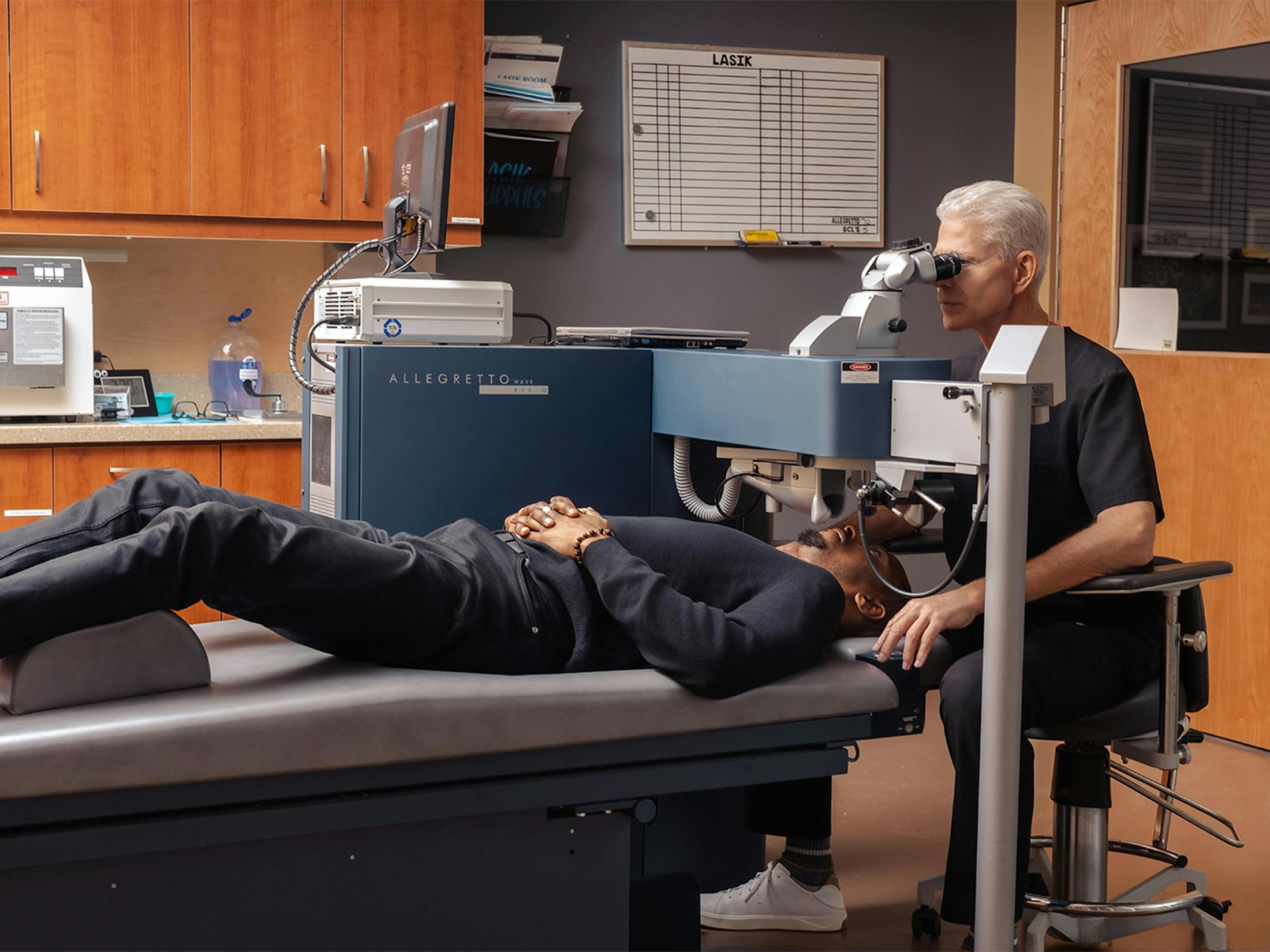

See Clearly. Live Freely.
For most people who wear glasses or contact lenses, the idea of waking up and simply seeing clearly is a compelling one. LASIK makes that a reality for millions of people every year, and for the right candidate, it is one of the most rewarding decisions they will ever make for their quality of life.
At Boling Vision Center, LASIK is not a high-volume commodity procedure. It is a carefully considered, individually tailored treatment delivered by surgeons who take the time to ensure every guest is a genuine candidate and every outcome reflects the standard of excellence our practice is built on.
If you're ready to find out whether LASIK is right for you, schedule a consultation at any of our four Northern Indiana locations today.
What LASIK Corrects
LASIK is an FDA-approved laser vision correction procedure designed to address the refractive errors that make glasses and contact lenses necessary. It reshapes the cornea with a precise excimer laser to correct the way light focuses on the retina, producing clear, unaided vision for appropriately selected candidates.
Myopia (Nearsightedness)
Myopia occurs when the eye is slightly too long or the cornea is too curved, causing light to focus in front of the retina rather than on it. The result is clear vision up close and blurry vision at a distance. LASIK flattens the central cornea to redirect light onto the retina accurately, restoring clear distance vision.
Hyperopia (Farsightedness)
Hyperopia occurs when the eye is too short or the cornea too flat, causing light to focus behind the retina. LASIK steepens the central cornea to bring the focal point forward onto the retina, improving clarity at near and distance.
Astigmatism
Astigmatism results from an irregularly shaped cornea or lens that causes light to focus at multiple points rather than one, producing blurry or distorted vision at all distances. LASIK smooths and regularizes the corneal curvature to eliminate the irregularity and restore clear, single-focus vision.
Presbyopia
While LASIK doesn't reverse the age-related loss of near focusing ability that affects most people in their mid-forties, monovision LASIK, in which one eye is corrected for distance and one for near, can reduce dependence on reading glasses for some guests. This approach is discussed in detail during the consultation for guests in the presbyopic age range.

Pam WaltersWow! What an AMAZING and informative experience we had with Dr. Whitney Boling, Angela, Janette, and Noel today at the Elkhart campus! All of the staff were very pleasant and went above and beyond the normal expectations of customer service! Dr. Boling worked my mother in for a last-minute appointment and gave her a new lease and hope on life! Thank-you! God Bless!



Affording LASIK
LASIK is an investment in your vision and your quality of life, and at Boling Vision Center, we work to make that investment as accessible as possible.
Financing Options
We offer flexible financing options that allow guests to spread the cost of LASIK over time, making the procedure accessible without requiring a significant upfront payment. Our team will walk you through the available financing plans and help you find an arrangement that works for your budget.
FSA and HSA Eligibility
LASIK is an eligible expense under most Flexible Spending Accounts and Health Savings Accounts, which can provide meaningful tax savings when used to cover the cost of the procedure. If you have an FSA or HSA, we encourage you to discuss this option with your plan administrator and factor it into your planning.
The Long-Term Value of LASIK
While LASIK involves an upfront cost, most guests find that it pays for itself over time through savings on glasses, contact lenses, solutions, and eye exams for contact lens management. Our LASIK Savings Calculator helps put that long-term value in concrete terms.
Vision Insurance
Most standard vision insurance plans do not cover LASIK as it is considered an elective procedure. However, some plans offer a discount benefit for laser vision correction, and our team will help you determine what, if any, benefit your plan provides.

Why Choose Boling Vision Center for LASIK?
LASIK at Boling Vision Center means advanced technology, experienced surgeons, and a team that treats your vision with the seriousness and genuine care it deserves. From your first consultation through every post-operative visit, you're cared for by the same practice, the same providers, and the same dedicated team, in our own Joint Commission-certified INSIGHT Surgery Center.
With over 65 years of trusted community care and a commitment to outcomes that go beyond the expected, we're the vision correction choice Northern Indiana trusts. Amazing happens here.
LASIK Frequently Asked Questions
Am I a good candidate for LASIK?
LASIK candidacy depends on several factors, including corneal thickness and curvature, the stability and degree of your refractive error, pupil size, tear film health, and overall eye health. A comprehensive consultation is the only reliable way to determine whether you're a good candidate. Most adults between 18 and 45 with a stable prescription and otherwise healthy eyes are strong LASIK candidates, though some are better served by an alternative procedure. Our team will give you an honest assessment at your consultation.
Is LASIK painful?
No. Numbing drops are applied before the procedure, and most guests experience little to no discomfort during LASIK itself. Some guests experience mild pressure or a sensation of warmth during the flap creation, but pain is not typical. Some light discomfort, dryness, or sensitivity is common in the hours immediately after the procedure as the numbing drops wear off, but this typically resolves quickly with rest and prescribed eye drops.
How long does LASIK last?
For most guests, the vision correction achieved with LASIK is permanent. The corneal reshaping performed during the procedure does not reverse over time. However, LASIK does not prevent the natural changes that occur in the eye with age, including the development of presbyopia and cataracts, which may affect near vision and overall clarity in later life.
What is the difference between LASIK and PRK?
Both LASIK and PRK use an excimer laser to reshape the cornea and correct refractive errors, and both produce equivalent long-term outcomes. The primary difference is in how the corneal surface is accessed: LASIK creates a flap, while PRK removes the epithelium directly. PRK has a longer recovery period but is often the preferred option for guests with thinner corneas or other considerations that make flap creation less ideal. Your provider will recommend the most appropriate approach based on your individual anatomy.
Can LASIK treat both eyes at the same time?
Yes, and in most cases, both eyes are treated during the same procedure. Treating both eyes simultaneously is safe, convenient, and produces a more balanced visual experience during recovery than treating one eye at a time.
What if my vision changes after LASIK?
If the prescription changes significantly after LASIK, an enhancement procedure may be an option for appropriate candidates. The likelihood of needing an enhancement is low when surgery is performed on a stable prescription, which is one of the reasons we evaluate prescription stability carefully before recommending LASIK.
Are there risks to LASIK?
As with any surgical procedure, LASIK carries risks, and they are discussed in detail during your consultation. The most common side effects include temporary dryness, halos, and glare around lights, particularly at night, most of which resolve as the eye heals. Serious complications are rare with appropriately selected candidates and experienced surgeons. We believe in complete transparency about the risks and benefits of LASIK, and we encourage every guest to ask every question they have before deciding to proceed.
How soon can I return to work after LASIK?
Most guests return to office-based or desk work within one to two days of LASIK. More physically demanding occupations or those involving dust, water, or chemical exposure may require a longer wait. Your provider will give specific guidance based on your occupation and your individual recovery progress.