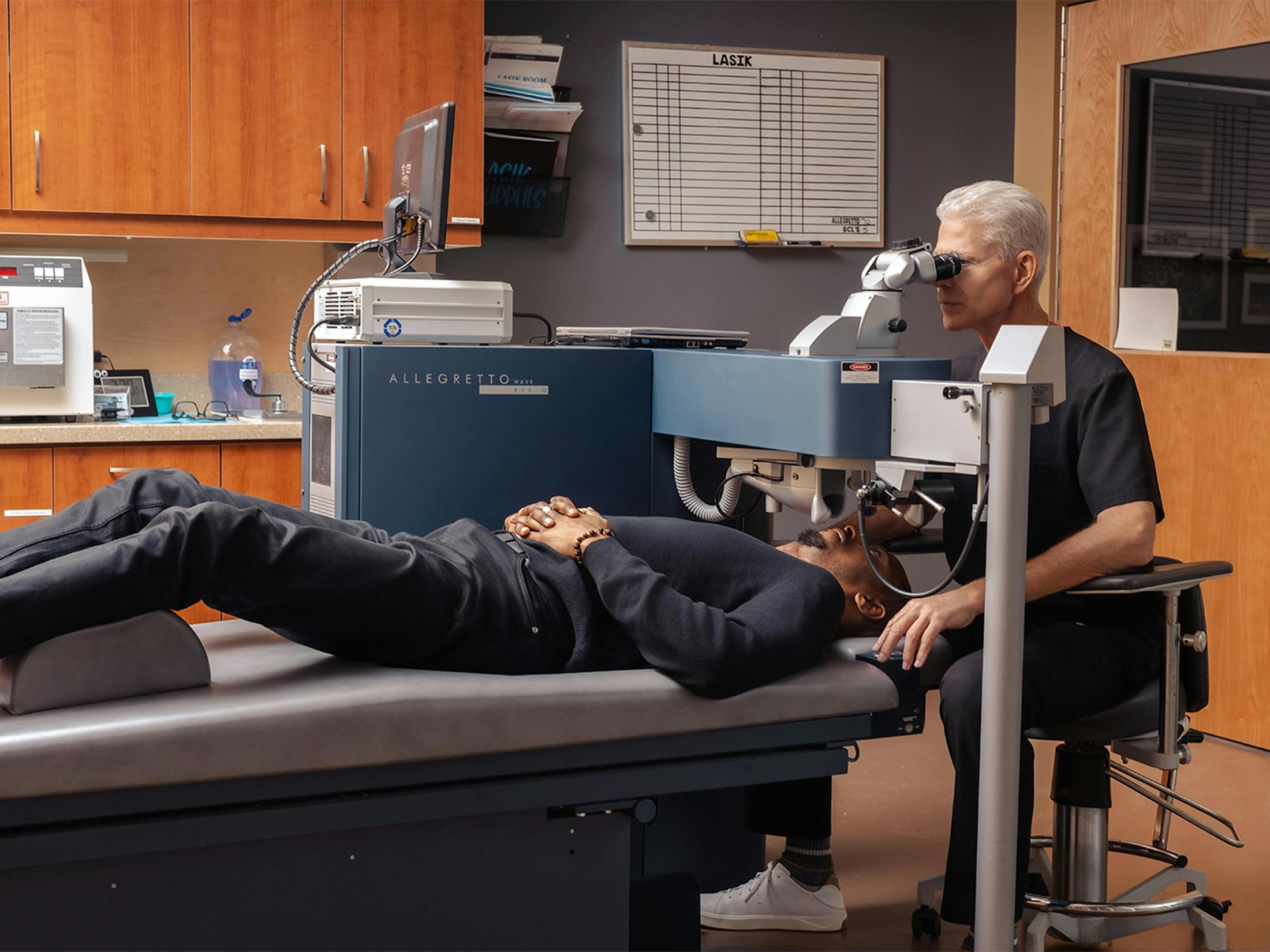
See Clearly. Live Freely.

For most people who wear glasses or contact lenses, the idea of waking up and simply seeing clearly is a compelling one. LASIK makes that a reality for millions of people every year, and for the right candidate, it is one of the most rewarding decisions they will ever make for their quality of life.

At Boling Vision Center, LASIK is not a high-volume commodity procedure. It is a carefully considered, individually tailored treatment delivered by surgeons who take the time to ensure every guest is a genuine candidate and every outcome reflects the standard of excellence our practice is built on.

If you're ready to find out whether LASIK is right for you, schedule a consultation at any of our four Northern Indiana locations today.

Is LASIK Right for You? Take Our Self-Test

Not sure if you're a LASIK candidate? Our quick, confidential self-test is a great first step. It takes just a few minutes and gives you a personalized sense of whether LASIK may be an option worth exploring further.

What LASIK Corrects

LASIK is an FDA-approved laser vision correction procedure designed to address the refractive errors that make glasses and contact lenses necessary. It reshapes the cornea with a precise excimer laser to correct the way light focuses on the retina, producing clear, unaided vision for appropriately selected candidates.

Myopia (Nearsightedness)

Myopia occurs when the eye is slightly too long or the cornea is too curved, causing light to focus in front of the retina rather than on it. The result is clear vision up close and blurry vision at a distance. LASIK flattens the central cornea to redirect light onto the retina accurately, restoring clear distance vision.

Hyperopia (Farsightedness)

Hyperopia occurs when the eye is too short or the cornea too flat, causing light to focus behind the retina. LASIK steepens the central cornea to bring the focal point forward onto the retina, improving clarity at near and distance.

Astigmatism

Astigmatism results from an irregularly shaped cornea or lens that causes light to focus at multiple points rather than one, producing blurry or distorted vision at all distances. LASIK smooths and regularizes the corneal curvature to eliminate the irregularity and restore clear, single-focus vision.

Presbyopia

While LASIK doesn't reverse the age-related loss of near focusing ability that affects most people in their mid-forties, monovision LASIK, in which one eye is corrected for distance and one for near, can reduce dependence on reading glasses for some guests. This approach is discussed in detail during the consultation for guests in the presbyopic age range.

Background media

Options for Permanent Vision Correction

LASIK is the most well-known vision correction procedure, but it isn't the only one. At Boling Vision Center's Vision Correction Center, we offer the full range of permanent vision correction options and take a genuinely individualized approach to helping each guest find the procedure that best suits their eyes, prescription, and lifestyle.

LASIK

The gold standard of laser vision correction, LASIK creates a thin corneal flap using a femtosecond laser, reshapes the underlying corneal tissue with an excimer laser, and repositions the flap, which adheres naturally without sutures. Recovery is rapid, with most guests achieving functional vision within 24 hours and experiencing little to no discomfort.

PRK (Photorefractive Keratectomy)

PRK is an excellent alternative for guests who aren't ideal LASIK candidates due to thinner corneas or other anatomical considerations. Rather than creating a flap, PRK treats the corneal surface directly after removing the epithelium. Recovery takes longer than LASIK, typically one to two weeks for vision to stabilize, but the long-term outcomes are equivalent, and there is no flap-related risk.

EVO ICL (Implantable Collamer Lens)

EVO ICL is a removable lens implanted behind the iris and in front of the natural lens, correcting vision without removing any corneal tissue. It is an excellent option for guests who are outside the prescription range for laser correction, have thinner corneas, or have dry eye, which makes laser procedures less ideal. EVO ICL also preserves the option for future cataract surgery without complication.

Refractive Lens Exchange (RLE)

RLE replaces the eye's natural lens with a premium intraocular lens, correcting vision much as cataract surgery does, but in an eye without a visually significant cataract. It is most appropriate for guests in the presbyopic age range who want comprehensive vision correction across all distances and are willing to eliminate the possibility of future cataract surgery as a separate procedure.

During your consultation, your provider will evaluate your eyes thoroughly and discuss which of these options best suits your individual situation.

Wow! What an AMAZING and informative experience we had with Dr. Whitney Boling, Angela, Janette, and Noel today at the Elkhart campus! All of the staff were very pleasant and went above and beyond the normal expectations of customer service! Dr. Boling worked my mother in for a last-minute appointment and gave her a new lease and hope on life! Thank-you! God Bless!

Pam Walters
Quote Background

LASIK Technology at Boling Vision Center

The outcome of any LASIK procedure is only as good as the technology used to plan and perform it. At Boling Vision Center, we invest in the advanced laser platforms and diagnostic systems that give our surgeons the precision and information they need to deliver consistently excellent results.

Advanced Wavefront Mapping

Before any LASIK procedure, we perform a comprehensive wavefront analysis that maps the unique optical characteristics of your eye in extraordinary detail, capturing not just the basic prescription but the subtle higher-order aberrations that standard glasses can't correct. This map becomes the blueprint for a treatment that is customized to your individual eye rather than a generic prescription.

Femtosecond Laser Flap Creation

The corneal flap in LASIK is created using a femtosecond laser, an ultrafast laser that produces a precisely controlled, uniform flap without the use of a mechanical blade. Femtosecond laser flap creation is safer, more precise, and more consistent than blade-based methods, and it allows the flap dimensions to be customized to the individual eye's anatomy.

Excimer Laser Treatment

The excimer laser reshapes the corneal tissue with sub-micron precision, guided by the wavefront map created during the pre-operative evaluation. Modern excimer platforms incorporate eye-tracking technology that monitors and compensates for involuntary eye movement during treatment, ensuring that every laser pulse lands exactly where it's intended, regardless of how the eye moves.

Advanced Diagnostic Imaging

Our pre-operative evaluation includes corneal topography and tomography, pachymetry, and other advanced imaging modalities that allow us to assess corneal structure in fine detail, identify any contraindications to LASIK, and plan the treatment with the accuracy that safe, effective outcomes require.

What Happens at Your Consultation

A LASIK consultation at Boling Vision Center is a thorough, unhurried evaluation designed to give both you and your provider a complete picture before any decision is made.

Comprehensive Diagnostic Testing

The consultation begins with a comprehensive series of measurements and imaging studies, including corneal topography and tomography, wavefront analysis, pachymetry to measure corneal thickness, pupil size measurement, tear film evaluation, and a full refraction. 

Contact lens wearers are asked to remove their lenses for a period before the consultation, as lens wear temporarily alters corneal shape and can affect the accuracy of measurements.

Candidacy Assessment

Your provider reviews the diagnostic findings and evaluates your candidacy for LASIK and, if relevant, alternative procedures. Factors assessed include corneal thickness and curvature, the degree and stability of the refractive error, pupil size, tear film health, and the overall health of the eye. Any finding that raises a concern about safety or outcomes is discussed openly and honestly.

Honest Conversation About Options

If LASIK is a strong option for your eyes, your provider will explain the procedure, the expected outcomes, the risks, and the recovery process in detail. If another procedure would serve you better, that recommendation will be made clearly and explained thoroughly. If you're not a candidate for any procedure, that will be communicated honestly as well.

We don't pressure guests toward any particular decision. Our goal is to ensure you leave the consultation with a complete understanding of your options and the confidence to make the right choice for your vision and your life.

Your Questions, Answered

The consultation is also an opportunity to ask every question you have. There are no questions too basic or too detailed. Our team takes whatever time is needed to ensure you feel fully informed before leaving.

Schedule A Consultation

Contact Us
Contact us media

LASIK Surgery Day

For most guests, the experience of LASIK surgery day is notably more straightforward and comfortable than they expected.

Preparation and Arrival

You'll arrive at INSIGHT Surgery Center having followed the pre-operative instructions provided at your consultation, including avoiding eye makeup, perfume, and cologne, and arranging for someone to drive you home. Our team will greet you and guide you through the final preparation steps, including the administration of eye drops and a brief pre-operative review.

The Procedure

The LASIK procedure itself takes approximately 15 minutes for both eyes, though the laser treatment portion is a matter of seconds per eye. You will be awake throughout but comfortable, with numbing drops ensuring no pain during the procedure. The femtosecond laser creates the corneal flap, the excimer laser reshapes the corneal tissue, and the flap is gently repositioned. You may be aware of pressure and light during the process, but discomfort is minimal.

Immediately After

Following the procedure, you'll rest briefly in our recovery area before being discharged. Vision is often noticeably clearer within hours of the procedure, though some blurriness, haziness, and light sensitivity are normal in the first day or two. Most guests can return to most normal activities within 24 to 48 hours.

What to Expect in Recovery

The first few days after LASIK typically involve some light sensitivity, occasional dryness, and mild fluctuation in vision as the eye heals. These symptoms improve steadily over the first week. Most guests achieve their best corrected vision within the first one to three months as the cornea fully stabilizes.

Post-operative appointments are scheduled at defined intervals to monitor healing and confirm that the outcome is progressing as expected. Our team is accessible between visits for any questions or concerns that arise during recovery.

Affording LASIK

LASIK is an investment in your vision and your quality of life, and at Boling Vision Center, we work to make that investment as accessible as possible.

Financing Options

We offer flexible financing options that allow guests to spread the cost of LASIK over time, making the procedure accessible without requiring a significant upfront payment. Our team will walk you through the available financing plans and help you find an arrangement that works for your budget.

FSA and HSA Eligibility

LASIK is an eligible expense under most Flexible Spending Accounts and Health Savings Accounts, which can provide meaningful tax savings when used to cover the cost of the procedure. If you have an FSA or HSA, we encourage you to discuss this option with your plan administrator and factor it into your planning.

The Long-Term Value of LASIK

While LASIK involves an upfront cost, most guests find that it pays for itself over time through savings on glasses, contact lenses, solutions, and eye exams for contact lens management. Our LASIK Savings Calculator helps put that long-term value in concrete terms.

Vision Insurance

Most standard vision insurance plans do not cover LASIK as it is considered an elective procedure. However, some plans offer a discount benefit for laser vision correction, and our team will help you determine what, if any, benefit your plan provides.

Background media

LASIK Specials

At Boling Vision Center, we periodically offer promotions and special pricing on LASIK to make this life-changing procedure more accessible. Our current specials are updated regularly, and our team is always happy to discuss what's available when you schedule your consultation.

Why Choose Boling Vision Center for LASIK?

LASIK at Boling Vision Center means advanced technology, experienced surgeons, and a team that treats your vision with the seriousness and genuine care it deserves. From your first consultation through every post-operative visit, you're cared for by the same practice, the same providers, and the same dedicated team, in our own Joint Commission-certified INSIGHT Surgery Center. 

With over 65 years of trusted community care and a commitment to outcomes that go beyond the expected, we're the vision correction choice Northern Indiana trusts. Amazing happens here.
Richard Boling II

LASIK Frequently Asked Questions

Am I a good candidate for LASIK?

LASIK candidacy depends on several factors, including corneal thickness and curvature, the stability and degree of your refractive error, pupil size, tear film health, and overall eye health. A comprehensive consultation is the only reliable way to determine whether you're a good candidate. Most adults between 18 and 45 with a stable prescription and otherwise healthy eyes are strong LASIK candidates, though some are better served by an alternative procedure. Our team will give you an honest assessment at your consultation.

Is LASIK painful?

No. Numbing drops are applied before the procedure, and most guests experience little to no discomfort during LASIK itself. Some guests experience mild pressure or a sensation of warmth during the flap creation, but pain is not typical. Some light discomfort, dryness, or sensitivity is common in the hours immediately after the procedure as the numbing drops wear off, but this typically resolves quickly with rest and prescribed eye drops.

How long does LASIK last?

For most guests, the vision correction achieved with LASIK is permanent. The corneal reshaping performed during the procedure does not reverse over time. However, LASIK does not prevent the natural changes that occur in the eye with age, including the development of presbyopia and cataracts, which may affect near vision and overall clarity in later life.

What is the difference between LASIK and PRK?

Both LASIK and PRK use an excimer laser to reshape the cornea and correct refractive errors, and both produce equivalent long-term outcomes. The primary difference is in how the corneal surface is accessed: LASIK creates a flap, while PRK removes the epithelium directly. PRK has a longer recovery period but is often the preferred option for guests with thinner corneas or other considerations that make flap creation less ideal. Your provider will recommend the most appropriate approach based on your individual anatomy.

Can LASIK treat both eyes at the same time?

Yes, and in most cases, both eyes are treated during the same procedure. Treating both eyes simultaneously is safe, convenient, and produces a more balanced visual experience during recovery than treating one eye at a time.

What if my vision changes after LASIK?

If the prescription changes significantly after LASIK, an enhancement procedure may be an option for appropriate candidates. The likelihood of needing an enhancement is low when surgery is performed on a stable prescription, which is one of the reasons we evaluate prescription stability carefully before recommending LASIK.

Are there risks to LASIK?

As with any surgical procedure, LASIK carries risks, and they are discussed in detail during your consultation. The most common side effects include temporary dryness, halos, and glare around lights, particularly at night, most of which resolve as the eye heals. Serious complications are rare with appropriately selected candidates and experienced surgeons. We believe in complete transparency about the risks and benefits of LASIK, and we encourage every guest to ask every question they have before deciding to proceed.

How soon can I return to work after LASIK?

Most guests return to office-based or desk work within one to two days of LASIK. More physically demanding occupations or those involving dust, water, or chemical exposure may require a longer wait. Your provider will give specific guidance based on your occupation and your individual recovery progress.

Amazing Happens Here

Three generations. One unwavering standard.

Contact Us
Accessibility: If you are vision-impaired or have some other impairment covered by the Americans with Disabilities Act or a similar law, and you wish to discuss potential accommodations related to using this website, please contact our Accessibility Manager at (574) 293-3545.
Contact Us