Clear Vision Without a Flap

PRK, or Photorefractive Keratectomy, was actually the first approved laser vision correction procedure, predating LASIK by several years. While LASIK has become the more widely known option, PRK remains an excellent choice for many guests, and in certain situations it is the better procedure.

At Boling Vision Center's Vision Correction Center, we evaluate every vision correction candidate thoroughly and recommend the approach that best suits their individual eyes, prescription, and lifestyle, whether that's LASIK, PRK, EVO ICL, or RLE.

Schedule a consultation at any of our four Northern Indiana locations to find out whether PRK is the right choice for you.

What PRK Corrects

Like LASIK, PRK uses an excimer laser to reshape the cornea so that light focuses accurately on the retina. It corrects the same range of refractive errors:

  • Myopia (Nearsightedness): PRK flattens the central cornea to improve distance vision.
  • Hyperopia (Farsightedness): PRK steepens the central cornea to bring the focal point forward.
  • Astigmatism: PRK smooths corneal irregularities to restore clear, single-focus vision at all distances.

Many guests achieve 20/20 vision or better after PRK.

Banner media

How PRK Differs From LASIK

Both PRK and LASIK use the same excimer laser to reshape the corneal tissue and correct refractive error. The key difference is in how the corneal surface is accessed.

The Flap-Free Difference

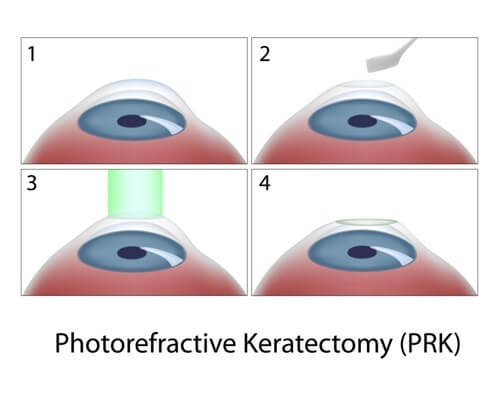
LASIK creates a thin corneal flap using a femtosecond laser, treats the tissue beneath it, and repositions the flap. PRK removes a microscopic layer of the outermost corneal surface, the epithelium, treats the underlying tissue directly, and allows the epithelium to regenerate naturally over approximately one week.

Because no flap is created, PRK is the preferred option for guests with corneas that are too thin or too curved for LASIK to be safely performed.

PRK for Military and Occupational Requirements

PRK is also the preferred option for guests with certain occupational requirements, including those in branches of the armed forces where flap-related restrictions apply. Boling Vision Center has extensive experience working with active duty military members and their specific vision correction requirements, and our team is well-equipped to navigate those guidelines with you.

Recovery Tradeoffs

The primary tradeoff with PRK is recovery. PRK involves a slightly longer healing period and more temporary discomfort in the first week compared to LASIK. Long-term outcomes, however, are equivalent between the two procedures, and for the right candidate, PRK is every bit as effective a path to clear, lasting vision.

prk graphic

The PRK Procedure

The PRK procedure is straightforward, typically lasting less than five minutes, with most guests in and out of the laser suite in under 15 minutes. Here is what to expect:

  • Anesthetic eye drops are applied to numb the eye.
  • A microscopic layer of outer corneal tissue is gently removed to expose the inner corneal surface.
  • Computer-controlled pulses of cool excimer laser light reshape the inner corneal layers to match the precise correction needed.
  • A soft bandage contact lens is placed on the cornea to protect the surface as the epithelium regenerates over the following week.

You will be awake throughout the procedure. Relaxation medication is provided, but it does not put you to sleep. Most guests describe the experience as mildly uncomfortable rather than painful.

Recovery After PRK

PRK recovery takes slightly longer than LASIK, and setting realistic expectations helps guests navigate the first week with confidence. In the days following PRK, guests typically experience:

  • Discomfort and possible mild swelling for five to eight days
  • Fluctuating vision and sensitivity to light during the first week
  • Temporary difficulty with night driving or halos around lights in the first several weeks, often related to dryness that resolves with artificial tears
  • Temporary difficulty seeing in dimly lit environments until the eye is fully healed

Meaningful vision improvement is typically achieved within five to eight days, with vision continuing to stabilize and refine over the following weeks. Full stabilization generally occurs within one to three months. If halos persist beyond the first several weeks, it may indicate mild undercorrection, which can be addressed with an enhancement procedure at no additional charge.

Banner media

I was very impressed with Boling Vision Center and all the staff I worked with. It was a very pleasant and helpful experience. I felt confident that we received quality treatment for my son’s eye that had been injured. I am glad I was referred to Boling by a friend, and I would definitely recommend Boling Vision Center to others.

Kaley Ostrom
Quote Background

Post-PRK Guidelines

Following PRK, adhering to your post-operative instructions is important for a smooth recovery and the best possible outcome. Key guidelines include:

  • Do not rub the eye for four weeks
  • Do not swim for two weeks
  • Avoid eye makeup for one week
  • Avoid getting soap, water, perfume, hairspray, or aftershave in the eyes for one week
  • Do not participate in contact sports for two weeks
  • Wear protective eyewear for three months during sports where eye contact is possible
  • Do not drive until vision is sufficiently clear

Your provider will give you a complete set of post-operative instructions specific to your procedure and situation before you leave INSIGHT Surgery Center on surgery day.

Woman smiling

Preparing for Your PRK Consultation

If you wear contact lenses, you'll need to discontinue wearing them before your pre-operative exam, as contacts temporarily alter corneal shape and affect the accuracy of measurements:

  • Soft contact lenses: discontinue two weeks before
  • Toric contact lenses: discontinue three weeks before
  • Hard or gas permeable contact lenses: discontinue five weeks before

Your provider will confirm the appropriate timeline for your specific lens type at the time of scheduling.

Affording PRK

At Boling Vision Center, we work to make PRK as financially accessible as possible. We offer flexible financing options, including interest-free plans and extended financing terms, and accept FSA and HSA funds as payment. Cash pay discounts are also available for guests who prefer to pay in full at the time of service. Our team will walk you through all available options at your consultation.

Banner media

Why Choose Boling Vision Center?

PRK at Boling Vision Center means advanced laser technology, experienced surgeons, and care that doesn't end when you leave the laser suite. From your pre-operative evaluation through every follow-up visit, you're supported by the same team in the same practice, with the same commitment to your outcome that has made Boling Vision Center the vision correction choice of Northern Indiana for over 65 years. Amazing happens here.

man getting his eye checked | child getting her eye checked | abstract art

Frequently Asked Questions PRK

Is PRK painful?

Most guests describe PRK as mildly uncomfortable rather than painful. Anesthetic drops numb the eye before the procedure, and discomfort during the treatment itself is minimal. The first week of recovery involves more noticeable discomfort than LASIK recovery, but this is temporary and manageable with prescribed medications and drops.

How long does PRK recovery take?

Most guests achieve functional vision within five to eight days of PRK. Vision continues to stabilize and refine over the following weeks, with full stabilization typically occurring within one to three months. The recovery timeline is longer than LASIK but the long-term outcome is equivalent.

Is PRK permanent?

Yes. PRK produces permanent changes to the corneal shape and the vision correction it provides. Like LASIK, PRK does not prevent the natural changes that occur in the eye with age, including presbyopia and cataracts, but the refractive correction itself is lasting.

Can PRK eliminate my need for reading glasses?

PRK corrects distance refractive errors but does not address presbyopia, the age-related loss of near focusing ability that affects most people in their mid-forties. Monovision PRK, in which one eye is corrected for distance and one for near, is an option for some guests seeking to reduce dependence on reading glasses. This approach is discussed in detail during the consultation.

Who is the best candidate for PRK over LASIK?

PRK is generally preferred over LASIK for guests with thinner or more steeply curved corneas that make flap creation inadvisable, those with occupational restrictions that preclude flap-based procedures, and those who participate in contact sports or activities where a flap could be at risk. Your provider will assess which procedure is most appropriate for your individual situation at your consultation.

How does PRK compare to EVO ICL or RLE?

PRK, like LASIK, is a laser procedure that reshapes the cornea and is best suited for guests with stable prescriptions within the treatable range who have adequate corneal tissue. EVO ICL adds a lens inside the eye without altering the cornea and is better suited for higher prescriptions or guests with dry eye. RLE replaces the natural lens and is most appropriate for guests in the presbyopic age range. Your provider will help you understand which option best fits your eyes and goals during your consultation.

Amazing Happens Here

Three generations. One unwavering standard.

Contact Us
Accessibility: If you are vision-impaired or have some other impairment covered by the Americans with Disabilities Act or a similar law, and you wish to discuss potential accommodations related to using this website, please contact our Accessibility Manager at (574) 293-3545.
Contact Us